Innovation at FunPlus Series – Part I

Inside FunPlus’s AI Innovation Incubation Team


Innovation is at the core of everything we do and aspire to here at FunPlus: from new and improved game experiences to optimized development, marketing pipelines, and even how we lead and incentivize our teams.

FunPlus CBO Chris Petrovic recently shared that AI fluency is becoming a fundamental prerequisite for gaming companies, FunPlus included. As we continue to explore how AI and other innovative technologies can be integrated into workflows across all aspects of a company’s operations, we will be sharing more learnings about how we are evolving as a company.

 

FunPlus

AI fluency is becoming a fundamental prerequisite for gaming companies.

Chris Petrovic, Chief Business Officer, FunPlus

Selecting different large language models for different business scenarios

In this first deep dive, we explore selecting different large language models for different business scenarios and building more efficient AI-powered workflows.

Internally, we have established an AI innovation incubation team, focused on building an AI-native platform that can support the full game-development pipeline. Respecting IP ownership and creative ideas is essential in this journey.

By experimenting with our own real development environments and an end-to-end data collection loop, we aim to turn production processes into data assets that can be recorded, verified, reviewed, and reused for agent learning, evaluation, and workflow optimization.

These tools will help to optimize the creative work being done by our team members and their ability to better support players.

FunPlus

“The human element remains essential.”

Chris Petrovic, Chief Business Officer, FunPlus

The Evaluation: Open-Source vs. Closed-Source AI Models

Recently, this internal incubation team conducted a set of internal technical evaluations focused on how open source (in this case Kimi K3) and a selection of closed source AI models perform in real game-development scenarios: whether they can enter engineering, debugging, and QA workflows (some of the areas where we know AI can be of the biggest help), and whether they can bring measurable improvements in efficiency and quality.


The evaluation included two main types of tasks:

  • The first was full gameplay implementation: models started from the same game-rendering engine environment and the same gameplay specification, then independently built a complete management-game loop.
  • The second was real rendering bug investigation: historical issues that had already been fixed in past projects were reintroduced, previous fixes and prior answers were removed, and models were asked to independently reproduce, investigate, validate, and fix the issues from the same starting point.


Evaluation Area Anonymized Closed-Source Models Kimi K3 Key Takeaway
Full gameplay implementation: first-round result Closed-source model 1: 62 passed / 4 for review / 0 failed; closed-source model 2: 58 passed / 8 for review / 0 failed 62 passed / 4 for review / 0 failed Kimi K3 achieved a strong first-round result among the evaluated models and demonstrated the ability to complete a complex playable game loop.
Multi-round QA and fixes Closed-source model 1 completed 19 cumulative fixes; closed-source model 2 completed 16 cumulative fixes Completed 21 cumulative fixes All models required human QA and in-game validation tools, showing that real game-development evaluation cannot rely on automated scores alone.
Final validation Both closed-source models passed final human validation Passed final human validation Frontier coding models are already capable of completing relatively complex game-engineering tasks; the differences lie mainly in validation behavior and fixing paths.
Reproducible rendering issue Completed in approx. 19 minutes; identified the root cause; validated the fix, eliminating 100% of polluted pixels Completed in approx. 58 minutes; identified the root cause and further verified that the apparent “deformation” was a visual artifact, with only 0.01% shape deviation The closed-source model was faster, while Kimi K3 produced a more detailed evidence chain. Both showed engineering value on reproducible issues.
Intermittent black-frame issue Provided a symptom-level mitigation in approx. 37 minutes, but did not observe a real black frame and did not identify the final root cause Identified the full causal chain in approx. 3.8 hours; stress testing showed 0 black frames after the fix For rare, unstable, and hard-to-reproduce issues, Kimi K3 placed more emphasis on reproduction, stress testing, and evidence-based root-cause validation.
Key validation evidence Faster convergence, better suited to stable reproduction and quick mitigation scenarios 26.9% stress-test reproduction rate; 896 black frames all matched abnormal draw order; 1,664 healthy frames all matched normal draw order Closed-source models are more delivery-oriented, while Kimi K3 is more suited to deep validation. The two model types fit different production workflows.

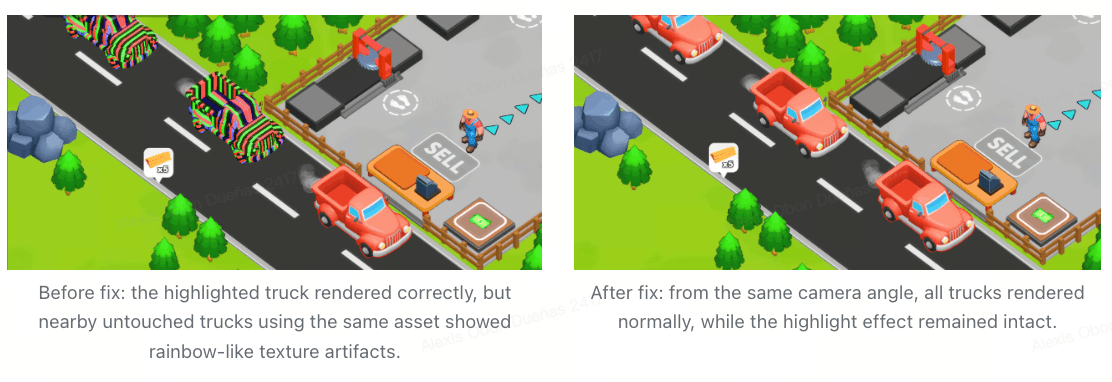
Before-and-after comparison from an isometric farming/trucking game: left image shows two trucks with glitchy rainbow texture artifacts near a highlighted red truck; right image shows the same scene with all trucks rendering normally after a rendering fix, with captions explaining the bug and fix

FunPlus


“It helps teams validate issues, improve quality, and have the time to pay more attention to the player experience itself.”

Chris Petrovic, Chief Business Officer, FunPlus

What We Found

These results do not propose a simple ranking between open and closed models.

Closed-source models still offer clear value in mature integration, response speed, and fast delivery.

Open models such as Kimi K3 may be better suited to tasks that require long context, repeated validation, and rigorous evidence chains, such as complex bug investigation, QA automation, codebase understanding, specification-gap detection, and engineering retrospectives. The human element remains essential.

The Human Element Remains Essential

Through real game-development tasks, we hope to understand where different AI tools fit best and turn those findings into reusable methods for our teams. AI should support more reliable production workflows, not replace human creative judgment. It helps teams validate issues, improve quality, and have the time to pay more attention to the player experience itself.

At FunPlus, this is the value of internal AI evaluation and innovation incubation. 

Keep an eye on this space, the FunPlus Spotlight Insider Info. We will keep bringing you an inside look at how FunPlus is evolving.

Stay tuned!


Innovation at FunPlus, Part I: a banner featuring Chris Petrovic in a portrait framed by orange circuit-board graphics and a brain-with-microchip icon labeled 'AI,' set against a dark background with the FunPlus logo

FunPlus


About FunPlus

FunPlus is one of the largest privately held companies in all of gaming. Founded in 2010, it is a global creator of interactive entertainment experiences powered by technology, with cross-platform game development and IP creation at its core.

FunPlus is an organization that fosters top industry talent, with around 2,000 team members based in offices and studios across three continents. These talented creative teams are well-known for developing hugely popular cross-platform titles, including:

It starts with you!

At FunPlus, we are passionate about creating entertaining experiences, surrounding ourselves with the best and brightest talent, and providing them with the opportunity to do their best work.

Think you have what it takes? Check out our career opportunities and join us!

▶ Open positions: https://funplus.info/WeAreHiring

FunPlus Social Media channels